Picking the best SEO tools for small business in 2026 isn't about grabbing the platform with the longest feature list — it's about matching software to the one job you actually need done this quarter: keyword research, a technical audit, local visibility, or backlink tracking.
- Semrush is the best overall pick among SEO tools for small business, pairing keyword research with full-site audits.
- Google Business Profile wins for local visibility since it directly controls map pack placement.
- Google Search Console is the most hands-on starting point for tracking technical health without extra software.
- Ahrefs and Screaming Frog cover backlink analysis and deep technical crawls once a site grows past a few dozen pages.
- Software surfaces the problems — fixing them at scale in 2026 usually takes a strategy behind the dashboard.
Why this matters
Most small business owners buy an SEO tool the same way they buy a treadmill: excited for a week, then it sits there generating reports nobody reads. The HiveHub Creative team sees this constantly — a dashboard full of red flags and nobody assigned to fix them.
That's the real gap in 2026. The best SEO tools for small business don't just collect data, they point at a next step. If a tool spits out 40 crawl errors and no owner, it's not doing its job — it's just adding to the noise.
“A tool doesn’t build your SEO strategy — it just tells you whether the strategy you don’t have is working.”
What makes the best SEO tool for small business
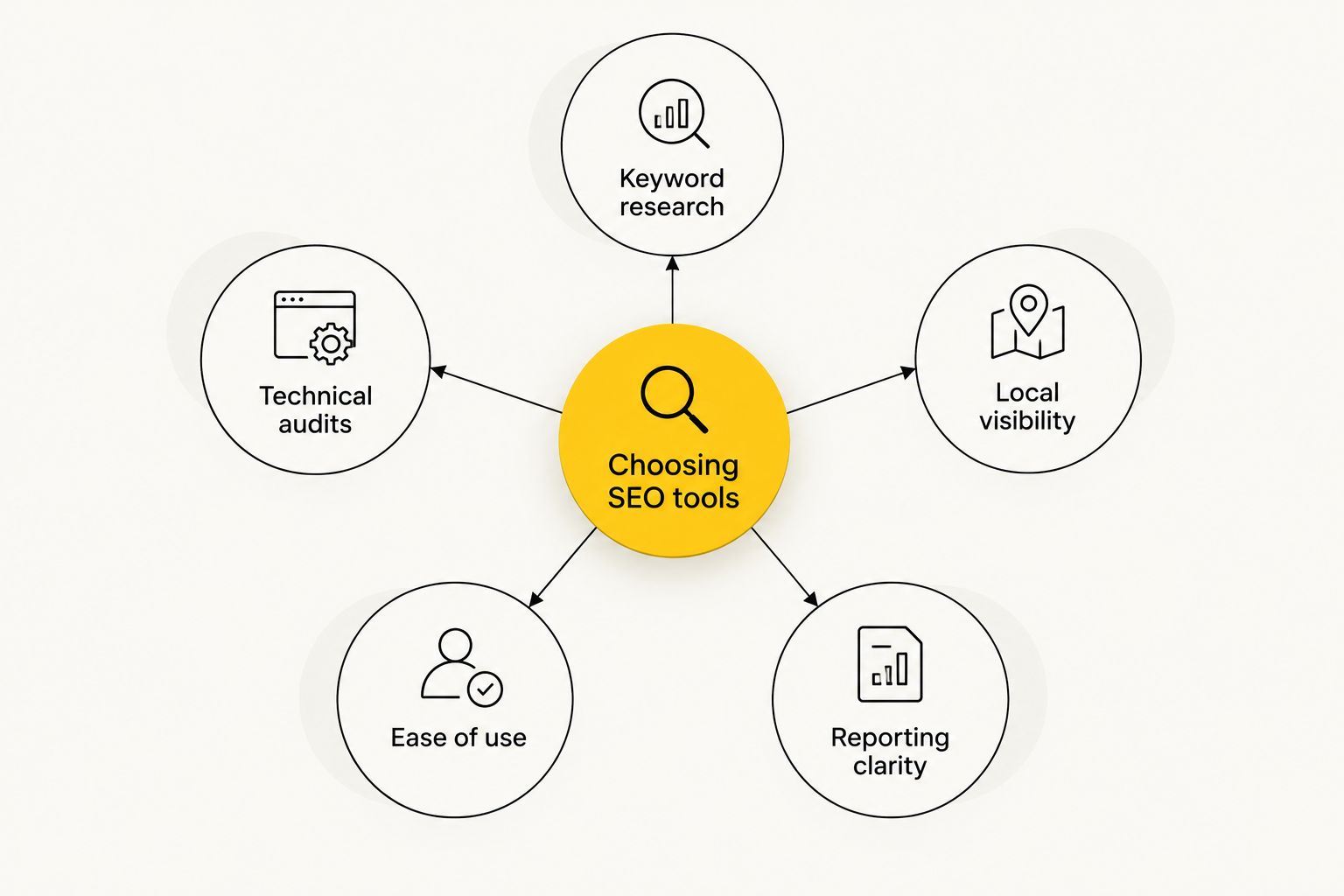
Before ranking anything, here's what actually separates a useful tool from a shiny dashboard:
- Keyword research depth — coverage from head terms down to long-tail questions customers actually type
- Technical audit range — crawl errors, page speed flags, indexation problems caught before Google notices
- Local search features — map pack tracking, review monitoring, citation consistency checks
- Ease of use — how much SEO background you need before the numbers mean anything
- Reporting clarity — a to-do list versus a spreadsheet of jargon
- Fit with a broader strategy — does it just report, or feed an actual action plan
At a glance
| Tool | Best For | Standout Feature | Key Limitation |
|---|---|---|---|
| Semrush | Overall keyword research and site audits | Combines rank tracking, audits and competitor gaps in one login | Steep learning curve for a first-time user |
| Google Business Profile | Local visibility and map pack ranking | Direct control over how the business appears in local search | Doesn't touch on-page or technical SEO at all |
| Google Search Console | DIY technical health monitoring | Straight-from-Google indexing and crawl data | Raw data with no built-in action plan |
| Ahrefs | Backlink analysis and content gap research | One of the largest backlink indexes on the market | Overkill for a single-location service business |
| Screaming Frog | Deep technical crawls on larger sites | Crawls every page and flags broken links, redirects and duplicate tags | Requires SEO knowledge to interpret the crawl |
| Ubersuggest | Beginners easing into keyword research | Simple interface with fewer overwhelming menus | Thinner data set than Semrush or Ahrefs |
1. Semrush: best SEO tool for competitive keyword research
Semrush pulls keyword volume, competitor rankings, and site audit flags into one dashboard, which is why it's the closest thing to an all-in-one pick among SEO tools for small business in 2026.
Semrush pros:
- Competitor keyword gap reports show exactly which terms a rival ranks for and you don't
- Site audit tool flags technical issues in plain language, not just error codes
- Position tracking updates rankings on a regular schedule so trends are visible
Semrush cons:
- The interface throws a lot of menus at a first-time user
- Some reports need SEO context to interpret correctly
Best for: owners who want one tool covering keyword research and technical audits together. Verdict: Buy.
2. Google Business Profile: best SEO tool for local visibility
Google Business Profile is the single biggest lever for showing up in the map pack — the three-listing block that appears above organic results for "near me" searches.
Google Business Profile pros:
- Directly controls map pack eligibility, which no third-party tool can replicate
- Review and Q&A sections build trust signals right in the search results
- Posts and photo uploads keep the listing active between website updates
Google Business Profile cons:
- Zero visibility into technical or on-page SEO issues
- Categories and attributes require regular upkeep to stay accurate
Best for: local service businesses competing for map pack spots. Verdict: Buy.
3. Google Search Console: best SEO tool for DIY technical monitoring
Search Console shows exactly how Google crawls and indexes a site — which pages rank, which ones got dropped, and which links are broken from Google's own point of view.
Google Search Console pros:
- Data comes straight from Google, not a third-party estimate
- Flags indexing problems before they tank a page's visibility
- Search query reports show the exact terms driving clicks
Google Search Console cons:
- No built-in action plan — it reports the problem, not the fix
- Interface takes some getting used to for a first-time user
Best for: owners who want a direct line into how Google actually sees their site. Verdict: Buy.
4. Ahrefs: best SEO tool for backlink analysis
Ahrefs built its reputation on one of the largest backlink indexes available, making it the go-to when a site needs to understand who's linking to it and who's linking to competitors.
Ahrefs pros:
- Backlink index depth catches links other tools miss
- Content gap reports show topics competitors rank for that a site hasn't covered
- Site explorer breaks down a competitor's entire organic footprint
Ahrefs cons:
- More firepower than most single-location businesses need
- Learning curve rivals Semrush's, without the same all-in-one reporting
Best for: businesses actively building backlinks or researching competitor content strategy. Verdict: Hold — worth it once link building becomes a real priority, not before.
5. Screaming Frog: best SEO tool for deep technical crawls
Screaming Frog crawls a website page by page, flagging broken links, duplicate title tags, missing meta descriptions, and redirect chains that quietly drag down rankings.
Screaming Frog pros:
- Crawls every page on a site, not a sample
- Catches duplicate content and tag issues other tools summarize too loosely
- Exports data for a developer to fix directly
Screaming Frog cons:
- The output is a raw crawl, not a prioritized list
- Requires enough SEO background to know which flags actually matter
Best for: sites over 50 pages that need a full technical audit. Verdict: Hold — bring it in for a periodic audit rather than daily use.
6. Ubersuggest: best SEO tool for SEO beginners
Ubersuggest strips keyword research down to a simpler interface, which makes it a reasonable entry point for an owner who's never touched an SEO tool before.
Ubersuggest pros:
- Fewer menus and simpler navigation than Semrush or Ahrefs
- Keyword suggestions come with basic difficulty and volume estimates
- Content ideas feature surfaces topics based on top-ranking pages
Ubersuggest cons:
- Data set is noticeably thinner than Semrush or Ahrefs
- Site audit feature is basic compared to dedicated crawl tools
Best for: an owner testing the waters before committing to a full SEO platform. Verdict: Wait — fine for learning the ropes, but expect to outgrow it.
How we ranked
Each tool got weighed against the six criteria above — keyword depth, technical range, local features, ease of use, reporting clarity, and strategy fit. None of these tools wins across every criterion; that's the point. The ranking reflects which job each one does best, not which one has the most buttons.
Which SEO tool should you choose?
If you want one dashboard covering keyword research and technical health, Semrush is the default pick for 2026. If your business lives or dies on local search — a plumber, a salon, a bus charter company — Google Business Profile matters more than any paid platform. And if you're not ready to commit to a subscription yet, Google Search Console gives you real data at no extra cost of complexity.
Here's the catch none of these tools solve on their own: software tells you what's wrong, it doesn't do the fixing. That's where an agency earns its keep — turning a stack of crawl errors and keyword gaps into an actual sequence of work. Curious what that costs before you commit to anything? The how much does SEO cost for small businesses breakdown covers what typically goes into a monthly engagement.
Get a strategy, not just a dashboard
HiveHub Creative turns SEO tool data into an actual plan for traffic and leads.
FAQ
What are the best SEO tools for small business in 2026?
Semrush leads for combined keyword research and site audits, Google Business Profile wins for local visibility, and Google Search Console is the most direct way to monitor technical health. Ahrefs and Screaming Frog fit once a site outgrows the basics.
Is Semrush better than Ahrefs for small business SEO?
Semrush is the stronger all-in-one pick because it pairs keyword research with site audits in one login. Ahrefs pulls ahead specifically for backlink analysis, so the right answer depends on whether link building is a current priority.
Do I need Google Search Console if I already use Semrush?
Yes — Search Console shows exactly how Google crawls and indexes a site, which is data no third-party tool can fully replicate. It’s a direct line into Google’s own view, not a duplicate of what Semrush reports.
How much does SEO cost for a small business?
Costs vary based on the scope of work, from a one-time technical audit to an ongoing monthly engagement. The specifics depend on site size, competition, and how much hands-on strategy is involved.
What’s the best tool for tracking local SEO rankings?
Google Business Profile is the best tool for local visibility because it directly controls how a business appears in the map pack, tied straight to Google’s own local search index. No third-party tool has that same level of control.
Can Ubersuggest replace Semrush or Ahrefs for keyword research?
Ubersuggest works as a starting point for basic keyword ideas, but its data set is thinner than Semrush or Ahrefs. Most businesses outgrow it once they need deeper competitor analysis.
Which SEO tool works best for local service businesses?
Google Business Profile should be the first tool set up for any local service business, since map pack visibility drives most "near me" traffic. Search Console and Semrush layer on top once the profile is optimized.
Do small businesses need a technical SEO tool like Screaming Frog?
Only once a site passes roughly 50 pages or shows signs of crawl issues, broken links, or duplicate tags. Smaller sites can usually get by on Search Console alone for technical monitoring.
One last thing
Most small business owners buy an SEO tool, log in twice, then let the subscription run untouched for months — the tool didn't fail, the follow-through did. The best SEO tools for small business in 2026 only pay off when someone's actually assigned to act on what they flag.
Related guides