Half the "best local SEO tools" lists online rank software by affiliate payout, not by what actually moves a small business into Google's map pack. Here's the honest version: six tools worth knowing in 2026, what each one is actually good for, and which ones you can skip entirely.
- Google Business Profile is the free foundation every one of the best local SEO tools for small business builds on.
- BrightLocal wins for multi-location rank tracking and citation audits in 2026.
- Whitespark is the sharpest pick for fast citation building and cleanup.
- Yext only earns its complexity once you’re managing ten-plus physical locations.
- Software tracks your local rankings – it doesn’t replace the strategy work that changes them.
Why this matters
Local search decides whether a customer three miles away finds you or your competitor first. Google's local pack shows three businesses per search, and if you're not in that three-pack, you're on page two competing for scraps.
A rank tracker or citation tool can show you exactly why you're missing that three-pack – inconsistent business info, thin reviews, weak proximity signals. But a dashboard only reports the problem. Fixing it takes the same hands-on approach an agency like HiveHub Creative brings to SEO, web, and social work together, not another tab you check once a month and forget.
That's the lens for this list: which tools are worth paying attention to in 2026, and which ones are just noise dressed up as strategy.
What makes the best local SEO tool for small business
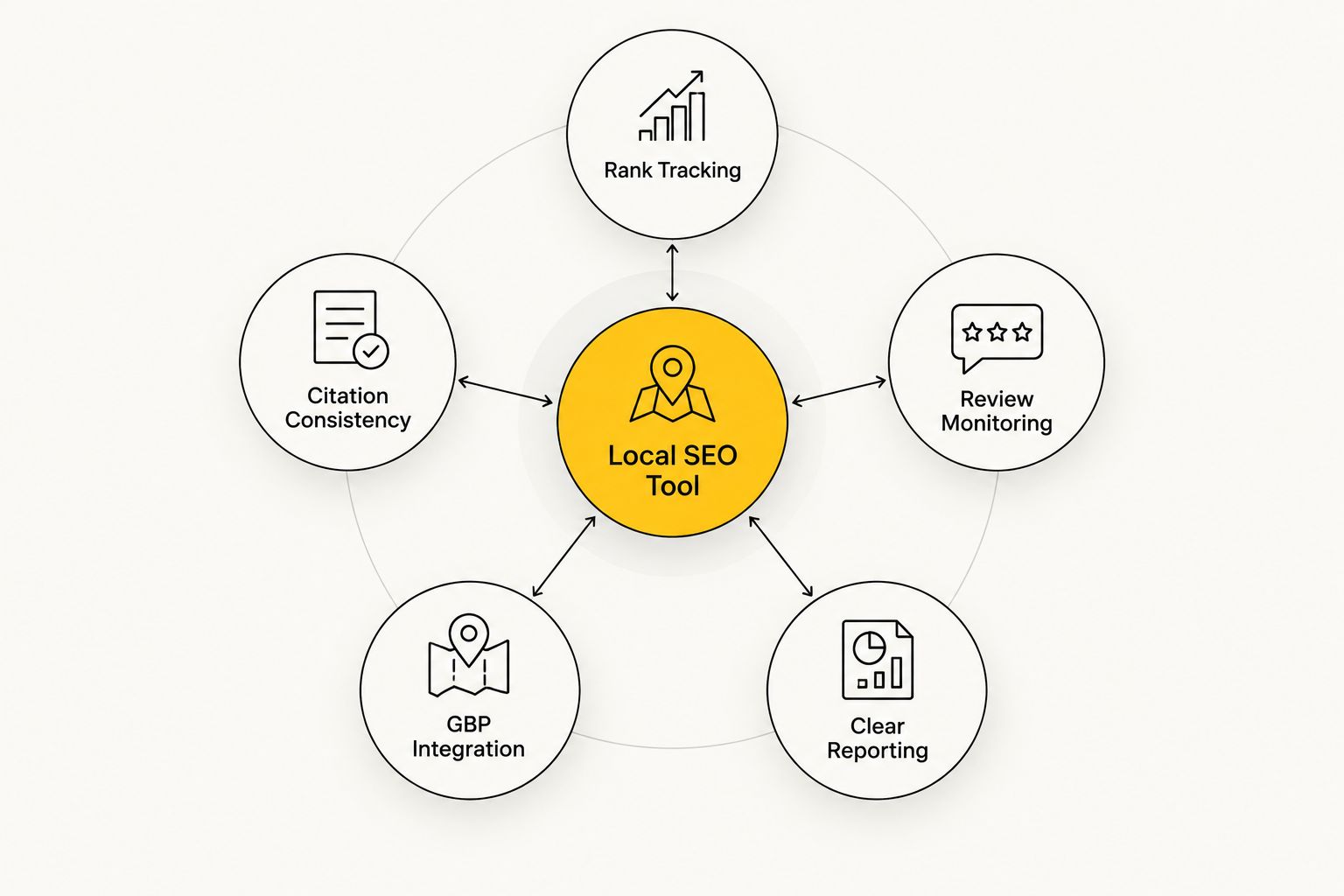
Before trusting any ranking, know what actually separates a useful tool from a shiny dashboard:
- Local pack visibility tracking – shows your position in the map pack, not just organic rank
- Citation and NAP consistency management – flags where your name, address, and phone don't match across directories
- Review monitoring – surfaces new reviews fast enough to respond before they sit unanswered
- Direct Google Business Profile integration – syncs data instead of requiring manual updates in two places
- Reporting a non-specialist owner can actually read – not a wall of jargon and unexplained scores
- Setup that doesn't require a dedicated in-house SEO hire
Local SEO tools at a glance
| Tool | Best For | Standout Feature | Key Limitation |
|---|---|---|---|
| Google Business Profile | Getting started for free | Direct control over your map pack listing | No competitor tracking or reporting built in |
| BrightLocal | Multi-location rank tracking | Rank tracking by neighborhood, not just city | Steeper setup for a single-location owner |
| Whitespark | Citation building and cleanup | Local Citation Finder flags missing directories | Rank tracking feels secondary to citations |
| Moz Local | Automated listing distribution | One update syncs across major directories | Review management is thin |
| Semrush | Combining local and organic SEO | Local toolkit sits inside a full SEO platform | Overkill if all you need is local |
| Yext | Enterprise multi-location brands | Manages listings across dozens of locations at once | Built for scale, not a single storefront |
1. Google Business Profile: best local SEO tool for getting started free
Google Business Profile is the free listing that controls how your business shows up in Google Search and Maps. Every other tool on this list either feeds data into it or pulls data from it, which makes it the one you fix first, not last. In 2026, an incomplete or unclaimed listing is still the single most common reason a small business doesn't show up in local search at all.
Google Business Profile pros:
- Free to claim and maintain
- Direct control over what shows in the three-pack
- Native review replies and Q&A management
- Posts and photo updates show right in the listing
Google Business Profile cons:
- No competitor or keyword rank tracking
- Reporting is basic compared to dedicated platforms
- Multi-location management gets clunky fast
Best for: any small business that hasn't fully optimized its Google listing yet.
Verdict: Buy. Non-negotiable – start here before spending on anything else.
2. BrightLocal: best local SEO tool for multi-location rank tracking
BrightLocal tracks where you rank in local search across specific neighborhoods and zip codes instead of one blended city-wide number. It also runs citation audits that flag exactly where your name, address, and phone stop matching across the web.
BrightLocal pros:
- Granular rank tracking by search grid, not just citywide average
- Citation audit catches NAP mismatches automatically
- White-label reporting works well if you're managing more than one location
BrightLocal cons:
- Takes real setup time to configure tracking grids correctly
- Reporting depth can overwhelm an owner without SEO background
Best for: businesses with two or more locations that need rank data by neighborhood.
Verdict: Buy. Worth it the moment you're past a single storefront.
3. Whitespark: best local SEO tool for citation building and cleanup
Whitespark specializes in finding and fixing inconsistent local citations – the directory listings referencing your business info across the web. Its Local Citation Finder flags directories competitors are listed on that you're missing, and it tracks local pack position specifically rather than blended organic rank.
Whitespark pros:
- Purpose-built for citation cleanup, not a bolted-on feature
- Surfaces directories competitors use that you don't
- Local-pack-specific rank tracking
Whitespark cons:
- Narrower feature set than an all-in-one platform
- Doesn't handle review management
Best for: a business with messy or duplicate directory listings dragging rankings down.
Verdict: Buy. The fastest fix for citation-driven ranking problems.
4. Moz Local: best local SEO tool for automated listing distribution
Moz Local pushes your business information out to major directories and data aggregators automatically, so one edit ripples across the web instead of requiring manual updates on ten separate sites. It's built for owners who want listings synced without touching each directory by hand.
Moz Local pros:
- One dashboard updates listings across major directories
- Duplicate listing detection
- Ties into Moz's broader domain data if you already use it
Moz Local cons:
- Review management is thinner than dedicated tools
- Local pack rank tracking isn't the core focus
Best for: an owner who wants listing consistency handled without manual directory edits.
Verdict: Hold. Solid utility tool – pair it with a dedicated rank tracker.
5. Semrush: best local SEO tool for combining local and organic SEO
Semrush's local toolkit lives inside its broader SEO platform, so local listing management, local rank tracking, and organic keyword research sit under one login. That matters if your local SEO and your blog or organic content strategy are supposed to feed each other in 2026, not run as two disconnected efforts.
Semrush pros:
- Local tools connect directly to keyword and content research
- Position tracking covers organic and local rankings together
- Useful if you're already running SEO content beyond just local
Semrush cons:
- More platform than a single-location business typically needs
- Local-specific features stay secondary to the core toolset
Best for: a business already investing in content and organic SEO that wants local folded in.
Verdict: Hold. Good only if you need the broader platform anyway.
6. Yext: best local SEO tool for enterprise multi-location brands
Yext manages listings, structured data, and search presence across dozens or hundreds of locations from one system. It's built for brands with a real footprint – franchises, multi-branch retailers, regional chains – not a single storefront trying to rank in one city.
Yext pros:
- Handles listing updates across large location counts efficiently
- Structured data feeds multiple search engines at once
- Built for consistency at brand scale
Yext cons:
- Overbuilt for a business with one or two locations
- Complexity outweighs the benefit for a small, local-only operation
Best for: franchises or regional chains with many physical locations.
Verdict: Skip. Unless you're managing ten-plus locations, this is more tool than you need.
How we ranked these
Every tool above got measured against the same six criteria: local pack visibility, citation consistency, review monitoring, Google Business Profile integration, reporting clarity, and setup difficulty for a non-specialist owner. None of the six tools score a clean sweep – that's the point. Pick based on which gap actually hurts your rankings in 2026, not which tool has the flashiest dashboard.
“A messy citation is worth more than a fancy dashboard – fix your NAP data before you buy a rank tracker.”
Talk strategy, not just tools
Get a straight read on what’s actually holding your local rankings back.
Which local SEO tool should you choose?
If you've done nothing yet, claim and fully build out Google Business Profile first – it's free and it's the account every other tool depends on. Once that's solid, add BrightLocal if you're tracking more than one location, or Whitespark if your citations are inconsistent across directories.
Skip Yext unless you're running ten-plus locations, and skip Semrush unless you're already paying for it for organic SEO work. None of these six tools substitute for a strategy that ties local SEO to your actual sales funnel – that's still a people problem, not a software one. If you're weighing tools against hiring it out, see what SEO actually costs for small businesses before deciding either way.
FAQ
What’s the best local SEO tool for small business in 2026?
Google Business Profile is the essential starting point because it’s free and controls your map pack presence directly. Beyond that, BrightLocal or Whitespark cover the rank tracking and citation work GBP doesn’t do on its own.
Is Google Business Profile enough on its own?
No – it gives you the listing but no competitor tracking, no citation audit, and thin reporting. Most small businesses pair it with at least one dedicated rank tracker or citation tool once they outgrow the basics.
Is BrightLocal better than Whitespark?
They solve different problems: BrightLocal is stronger for ongoing rank tracking across multiple locations, while Whitespark is sharper for finding and fixing inconsistent citations. A business with messy directory listings should start with Whitespark; a multi-location business should start with BrightLocal.
How much do local SEO tools cost in 2026?
Pricing varies by provider and by how many locations or keywords you’re tracking, so check current plans directly on each tool’s site before committing. Google Business Profile itself remains free.
Do I need a paid tool if I already rank well locally?
Ranking well today doesn’t mean you’ll hold that spot – a paid tracker catches competitor moves and citation drift before they cost you the three-pack. If you’re not tracking, you won’t see the drop until traffic already fell.
Can local SEO tools replace hiring an agency?
Tools report data; they don’t build strategy, write content, or fix a broken website that’s tanking conversions. Small businesses that pair software with hands-on SEO and web work tend to move faster than ones relying on dashboards alone.
How long does it take for local SEO tools to show results?
The tools themselves show tracking data immediately, but actual ranking movement from the fixes they surface typically takes weeks to months depending on how competitive your market is. Citation fixes and Google Business Profile completeness tend to show impact faster than broader organic changes.
Is Yext worth it for a single-location business?
Generally no – Yext is built for managing dozens or hundreds of locations at once, and that scale is wasted on a single storefront. A single-location business gets more value from Google Business Profile plus BrightLocal or Whitespark.
One last thing
None of these six tools rank you in the map pack by themselves. Google's local algorithm still weighs proximity, relevance, and prominence – and no dashboard manufactures the reviews or the content that build prominence. The tool tells you where you stand in 2026; the work of moving that needle still falls on a person.